ICF Basement Foundation vs. Traditional Concrete Walls in Ontario

Updated: Feb 20
Choosing the right foundation system is a key step in residential construction across Ontario. Climate variation, groundwater table changes, and soil saturation all affect how basement walls perform over time.
Both ICF basement foundations and poured concrete walls are proven systems, but their insulation, moisture behaviour, and long-term performance differ—especially under Ontario Building Code (OBC) requirements.
What Is an ICF Basement Foundation?
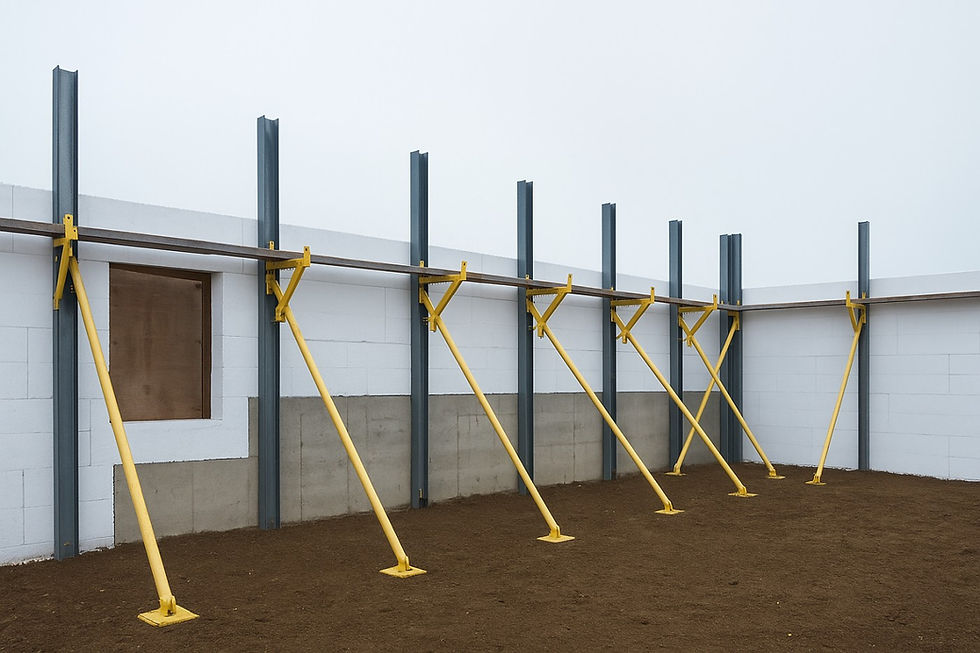
Insulated Concrete Forms (ICF) are interlocking foam blocks that stay in place after the concrete is poured. Reinforcing steel is installed inside the cavity, creating a continuous, monolithic wall.
Key benefits:
Continuous two-sided insulation
Minimal thermal bridging
More stable interior temperatures
Built-in air and vapour control when properly sealed
Protected curing environment per CSA A23.1 principles
Strong performance in areas with fluctuating water table conditions
ICF combines structure, insulation, and moisture control into one assembly, making it a high-efficiency option for Ontario basements.
How Poured Concrete Basement Walls Work
Poured concrete walls use temporary forms. After curing, forms are removed and insulation, waterproofing, and drainage layers are added separately.
Performance depends on:
Proper installation of exterior insulation
Effective waterproofing and drainage
Correct curing temperatures
Appropriate footing design where saturated soil reduces bearing capacity
Poured concrete is durable and widely used, but requires more components to match the airtightness and insulation quality of ICF.
Energy Performance
Ontario’s climate benefits from basement walls that limit heat loss and reduce temperature fluctuations.
ICF basement foundations offer:
Higher effective R-values
Less heat loss through thermal bridges
More consistent indoor comfort
Lower long-term energy demand
Traditional concrete can perform well, but only with proper insulation, vapour control, and careful installation.

Durability & Moisture Management
Both systems can achieve long-term durability when designed correctly.
ICF Walls:
Concrete cures in an insulated environment
Lower condensation potential
Better resilience in wet or saturated soil conditions
Poured Concrete Walls:
Highly durable when detailed and protected
Moisture resistance depends on added exterior layers
Reinforcement must meet CSA S16 corrosion requirements
More sensitive to groundwater pressure if detailing is incomplete
Considering ICF or traditional concrete foundations?
OBC Requirements
Both systems must comply with OBC Part 9 or Part 4. Engineering becomes necessary when:
Wall height exceeds 3.0 m
Groundwater or hydrostatic pressure is present
Lateral earth pressures exceed prescriptive values
Soil saturation reduces allowable bearing capacity
A structural engineer Ontario ensures reinforcement, wall thickness, and moisture protection meet performance and code requirements.
Comparative Table: ICF vs. Traditional Concrete Basement Walls

Feature | ICF Basement Foundation | Traditional Concrete Wall |
Insulation | Built-in, continuous | Installed separately |
Energy Efficiency | High | Moderate |
Moisture Control | Strong; integrated | Variable; relies on added layers |
Durability | Stable curing | Durable; needs protection |
OBC Compliance | Meets/exceeds with engineering | Meets prescriptive design |
Cost | Higher upfront | Lower upfront |
Construction | Foam + concrete | Concrete + added layers |
Conclusion
Both ICF basement foundations and poured concrete walls provide durable, code-compliant performance in Ontario. ICF offers stronger insulation and predictable moisture behaviour, while poured concrete remains a reliable option when properly detailed.
At Parsways, we provide OBC-compliant structural design and foundation engineering solutions for both ICF and traditional concrete systems across Ontario.
Co-authored by Khashayar Lotfalian and Negin Amani.
FAQ
1. Is ICF better for sites with a high water table?
Yes. Continuous insulation and reduced temperature cycling make ICF more stable in wet soil conditions.
2. Do ICF walls need extra insulation?
No. ICF provides two-sided continuous insulation.
3. When is engineering required for basement walls?
When wall height, groundwater conditions, or earth pressures exceed OBC Part 9 limits.

