Structural Capacity of Existing Slabs in Ontario: Evaluation and Practical Considerations
In many Ontario construction projects, existing concrete slabs are often assumed to have sufficient strength for new loading conditions. In practice, the structural capacity of existing slabs in Ontario is rarely defined with certainty.
Across industrial and commercial buildings in Ontario, including major urban centres such as Toronto and surrounding regions, changes in use, storage demand, or equipment installation frequently introduce loads that were not part of the original design.
Unlike new construction, evaluating an existing concrete slab load capacity in Ontario requires interpretation of available information, site conditions, and engineering judgment rather than relying solely on original drawings.
Structural Capacity of Existing Slabs: Limitations of Assumed Load Capacity

In many Ontario projects, floor load capacity is estimated based on previous use. However, this does not necessarily reflect actual structural performance.
A slab that performs under distributed loads may behave differently under concentrated loads from equipment or storage systems. Without verification, assumed load capacity can lead to overstress or long-term performance issues.
Conditions Requiring Evaluation of Existing Slab Capacity in Ontario Projects
Evaluation of structural capacity of existing slabs in Ontario becomes relevant when conditions change, including:
Installation of equipment
Increased storage loads
Interior modifications or tenant improvements
Change in building use
These changes affect how loads are transferred through the slab and into the supporting soil.
Slab-on-Grade Behaviour and Load Transfer in Existing Systems
Most floors in Ontario industrial and commercial buildings are slab-on-grade systems, where performance depends on both the slab and subgrade.
Load transfer depends on distribution as much as magnitude. Concentrated loads—such as rack legs or equipment bases—create localized stresses that differ from uniform loading.
Understanding this behaviour is essential when evaluating floor load capacity in Ontario buildings.
Factors Affecting Structural Capacity and Floor Load Capacity in Concrete Slabs
The structural capacity of existing concrete slabs depends on several variables:
Slab thickness and reinforcement
Subgrade support
Concrete condition (cracking or deterioration)
Type and distribution of loads
In many existing buildings across Ontario, this information may be incomplete. Engineering review focuses on resolving these uncertainties.
Industrial and Storage Loads: Implications for Floor Load Capacity
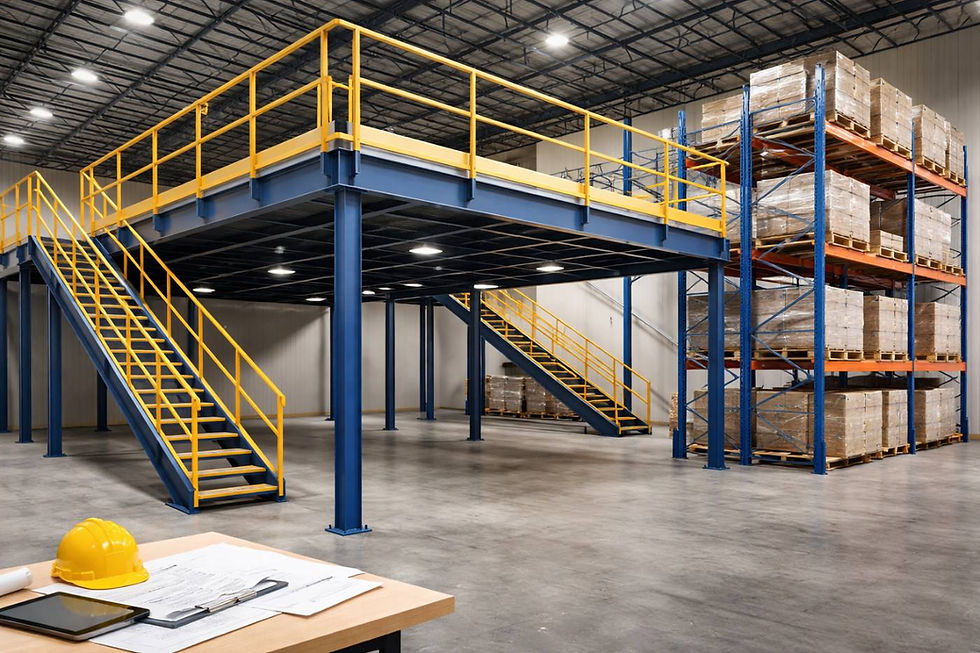
In industrial environments, floor load capacity is often challenged by evolving operational needs. Storage systems, forklifts, and equipment introduce concentrated and repetitive loads.
These may exceed original design assumptions, particularly in retrofit or tenant improvement projects.
Design Drawings vs As-Built Conditions in Existing Slab Systems
Original drawings do not always reflect current conditions. Modifications or undocumented changes can affect existing slab performance.
Differences between design intent and as-built conditions are a common source of uncertainty in determining structural capacity.
Engineering Review and Verification of Structural Capacity in Ontario Projects
A structural review of existing slab capacity in Ontario typically involves document review, site observation, and engineering interpretation. The goal is to confirm whether the slab can support the intended loads.
In projects across Ontario, this process helps identify limitations early and supports informed decisions.
At Parsways, this approach is commonly used to clarify floor load capacity and reduce uncertainty before construction or submission.
Permit and Compliance Considerations for Increased Floor Load Capacity in Ontario
In some Ontario municipalities, including Toronto and surrounding regions, increasing floor load capacity may require permit review or supporting engineering documentation.
This depends on project scope and alignment with the Ontario Building Code (OBC).
Conclusion
The structural capacity of existing slabs in Ontario cannot be defined through assumption alone. Changes in loading, incomplete documentation, and differences between design and as-built conditions all influence performance.
An engineering-based review helps establish realistic load capacity and supports safer project outcomes.
At Parsways, we work with contractors and project teams across Ontario to evaluate existing slab conditions and verify structural capacity where required—helping ensure decisions are based on verified performance rather than assumption.