Wood Shear Walls in Ontario Residential Buildings
Updated: Dec 20, 2025
Wood shear walls are a critical part of the lateral load–resisting system in wood-frame residential buildings across Ontario. Their primary role is to safely resist and transfer lateral loads—such as wind and seismic forces—from the structure to the foundation.
Proper structural engineering design and construction are essential to ensure code compliance, durability, and long-term performance under Ontario conditions.
What Is a Wood Shear Wall and How It Works
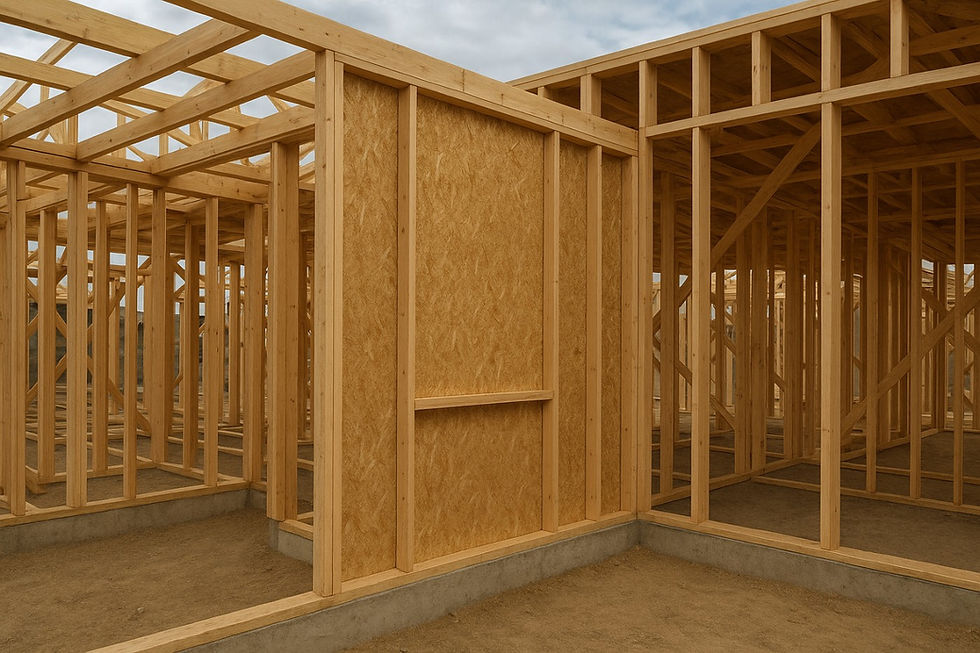
A wood shear wall is a vertical structural element designed to resist horizontal forces. It typically consists of wood studs, top and bottom plates, blocking, and rigid sheathing such as OSB or plywood, fastened together to act as a single structural panel.
From a structural engineering perspective, load transfer occurs as follows:
Lateral loads are applied to the building envelope
Sheathing resists in-plane shear forces
Forces are transferred to studs and boundary elements
Hold-downs and anchors deliver loads to the foundation
A continuous, uninterrupted load path is essential for the wall to perform as intended.
Ontario Code Requirements for Wood Shear Walls
In Ontario residential construction, shear wall design must comply with multiple regulations and standards:
Ontario Building Code (OBC): Part 9 (Prescriptive provisions for low-rise housing) ,Part 4 (Engineered design where prescriptive limits are exceeded)
National Building Code of Canada (NBCC): Wind and seismic load determination
CSA O86: Structural design of wood members and connections
CSA O325: Performance requirements for OSB and plywood sheathing
Key structural requirements include:
Storey drift limits: Typically in the range of 0.005h–0.007h, depending on building importance
Strength verification: Studs, sheathing, and connections must resist calculated loads
Anchorage: Proper hold-downs and anchors at wall ends and foundations
Durability: Materials must perform under moisture, freeze-thaw, and temperature variations common in Ontario

Key Structural Engineering Design Considerations
Effective shear wall design involves more than selecting sheathing thickness. Structural engineers must evaluate:
Continuous load path: No breaks between roof, walls, and foundation
Stiffness control: Proper sheathing type, thickness, and nailing pattern
Connection detailing: Correct fastener size, spacing, corrosion resistance
Openings: Reinforcement around windows and doors using blocking or straps
Seismic behavior: Appropriate ductility selection per NBCC seismic provisions
Typical Shear Wall Components and Functions
Component | Structural Role | Key Considerations |
Wood studs & plates | Vertical load and shear transfer | Engineered sizing, spacing |
OSB / Plywood sheathing | Primary shear resistance | CSA O325 grade, thickness |
Nails / screws | Force transfer between members | Spacing, edge distance |
Hold-downs | Resist uplift and overturning | Capacity, foundation anchorage |
Blocking & straps | Reinforce openings and joints | Precise placement |
Advantages of Wood Shear Walls in Ontario Housing
Lightweight system with high strength-to-weight ratio
Good seismic performance due to inherent material ductility
Cost-effective and fast to construct
Compatible with common Ontario residential construction practices

Construction and Quality Control
Verification of sheathing certification stamps
Inspection of nailing patterns, spacing, and depth
Proper installation of hold-downs and anchors
Ongoing moisture protection and maintenance
Conclusion
Wood shear walls are fundamental to the structural engineering performance of residential buildings in Ontario. When designed in accordance with the OBC, NBCC, and CSA standards—and constructed with precision—they provide reliable resistance against wind and seismic forces.
At Parsways Inc., we provide structural engineering design, review, and inspection services for wood shear walls in Ontario residential projects, ensuring code-compliant load paths, reliable connections, and long-term structural performance.
FAQs
1. Are wood shear walls required in all Ontario homes?
Yes, all homes require lateral load resistance, though the design method varies under OBC Part 9 or Part 4.
2. Can openings reduce shear wall capacity?
Yes. Windows and doors must be properly reinforced to maintain structural performance.
3. When is engineered shear wall design required?
When wall heights, loads, or layouts exceed prescriptive OBC Part 9 limits.


