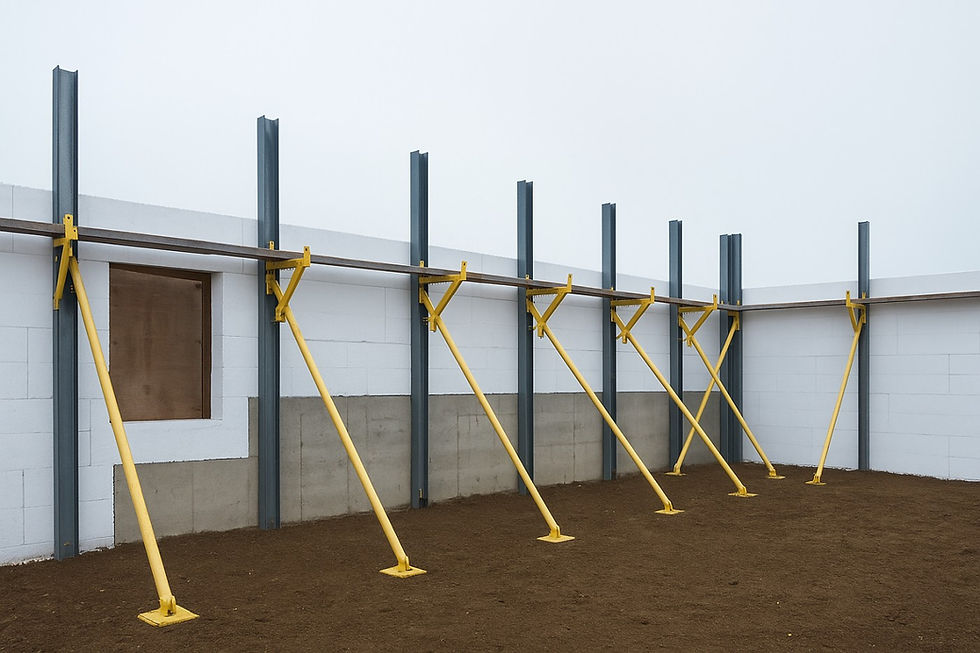
Non-Shrink Grout in Ontario: Structural Uses & OBC Compliance
Updated: Dec 3, 2025
In Ontario’s construction industry, structural reliability depends on precise load transfer and long-term material stability. Whether for new construction or retrofit work, these details determine how safely a structure performs over time.
Non-shrink cementitious grout ensures that stability. By maintaining its volume during curing, it provides a durable, gap-free connection between base plates, anchors, and foundations — a key factor in meeting OBC requirements and achieving lasting performance.

Why Non-Shrink Grout is Essential for Ontario Construction Projects
The primary benefits of non-shrink grout all relate to its ability to create a solid, stable, and reliable connection between structural elements.
Dimensional Stability: Maintains its volume from the moment it’s poured, preventing gaps, internal stresses, and uneven load transfer.
Uniform Load Transfer: Distributes compressive loads evenly from structural elements to foundations, minimizing vibration and preventing stress concentrations.
High Compressive Strength: Engineered to be stronger than typical concrete to support heavy columns and machinery. (Note: This strength is useless if the grout shrinks, as stability is the primary requirement.)
Durability in Ontario’s Climate: Resistant to freeze-thaw cycles, ensuring a long service life and reducing future repair costs.
Reliable Quality: Produced under strict CSA A23.1/A23.2 standards for consistent performance in critical structural applications.
Need Structural Guidance for Your Grouting Project?
Our engineers design and review base-plate grouting and foundation support systems for code-compliant, durable results.
Top 5 Applications of Non-Shrink Cementitious Grout in Ontario

Non-shrink grout is a versatile solution for a wide range of structural applications.
Grouting Column Base Plates (CSA S16): Fills the gap between steel columns or machinery and the foundation. This ensures perfect leveling and uniform load transfer, as required by CSA S16 detailing principles.
Anchoring Bolts and Dowels (CSA A23.3): Secures anchors with high bond strength. Per CSA A23.3, anchor design must ensure ductile failure (steel yielding), not a sudden, brittle bond failure.
Underpinning & Foundation Support: Fills the space between old and new foundation sections for seamless load transfer. This is a high-risk structural procedure that must be designed by a professional engineer.
Precast Concrete Connections: Fills joints and connection pockets between precast panels, columns, and beams, forming a single, monolithic structural system.
Structural Repairs & Void Filling: Fills confined voids, deep cracks, and honeycombing. Unrestrained applications can lead to cracking, and specialized repair mortars may be better for large surfaces.
Conclusion: The Foundation of Structural Integrity
While a high-performance material, non-shrink grout achieves its true potential only when it’s specified, placed, and cured correctly. With the right engineering oversight, it forms the critical link that transfers loads safely and keeps structures stable for decades.
At Parsways Inc., we design and review grout and base-plate systems to ensure every detail meets Ontario’s structural integrity standards.
Co-authored by Hoda Rajaeizadeh and Negin Amani.