U-Fill vs Lean Concrete in Ontario: Applications, Properties & Selection Guide
Understanding when to use U-Fill (Controlled Low-Strength Material / Flowable Fill) versus Lean Concrete helps engineers, contractors, and project managers choose the right material for trench backfilling, sub-bases, bedding, or void filling in Ontario projects. This comparison covers properties, typical uses, performance differences, and practical considerations from a structural engineering perspective.
What Is U-Fill (Flowable Fill / CLSM)?

U-Fill — also called flowable fill, controlled low-strength material (CLSM), or unshrinkable fill — is a highly workable, self-compacting cementitious material mainly used as a low-strength backfill. It consists of:
Portland cement binder
Water for flow
Fine aggregates and often supplementary materials (e.g., fly ash or slag)
Typical properties:
Low unconfined compressive strength (designed under ~2.1 MPa; common mixes <0.7 MPa in Ontario)
Self-leveling, no mechanical compaction needed
Can be excavated later if required, which is an important consideration in structural engineering for serviceability and future maintenance
Primary applications:
Backfilling utility trenches (water, sewer, telecom) without compaction
Filling abandoned underground structures and voids
Sub-base for pavements to reduce settlement
Slope stabilization and foundation void fill
Advantages of U-Fill:
Fast placement using volumetric trucks
Minimal labor and equipment required
Uniform density and reduced future settlement, which benefits structural stability
Mixes can incorporate by-products like fly ash for sustainability
What Is Lean Concrete?

Lean concrete is a mix with reduced cement content compared to traditional concrete, emphasizing high aggregate content and low binder. It is mainly used for non-structural, stable base layers rather than structural strength.
Typical features:
Low to moderate compressive strength (~5–10 MPa depending on mix)
Focused on dimensional stability and edge support, not heavy loads
Predictable brittle fracture during removal or demolition, useful in structural engineering planning
Primary applications:
Blinding layers beneath footings and slabs for a clean, level surface
Working platforms and assembly pads
Bedding for pipelines and subbases requiring stable surfaces
Temporary leveling layers in road, tunnel, or infrastructure projects
Lean concrete also reduces cement usage and allows easier cutting or fracturing during deconstruction.
Key Differences: U-Fill vs Lean Concrete
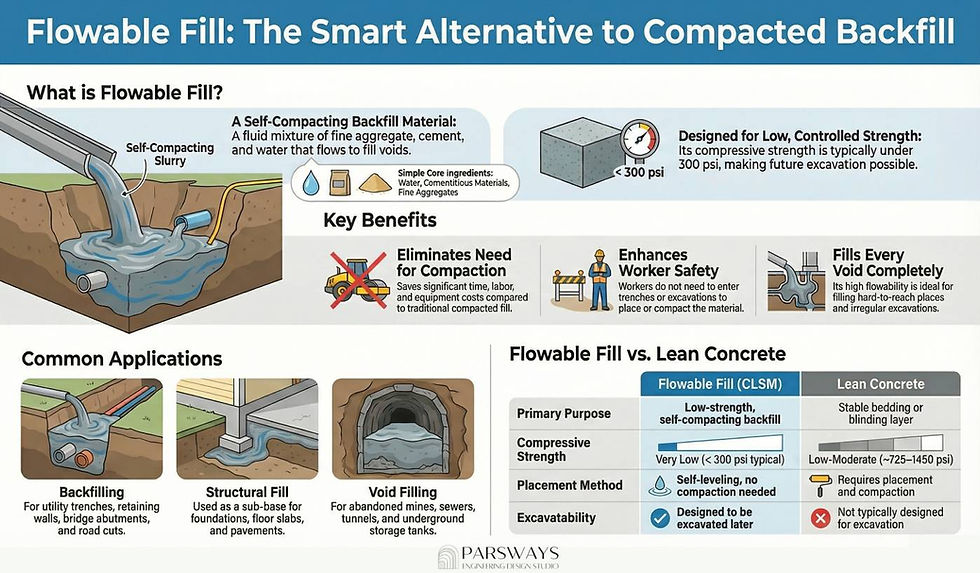
Property / Feature | U-Fill (CLSM) | Lean Concrete |
Primary Purpose | Low-strength, self-compacting backfill | Stable bedding, blinding, sub-base |
Compressive Strength | Very low (<0.7 MPa typical) | Low–moderate (~5–10 MPa) |
Placement | Self-leveling, no vibration | Requires conventional placement and compaction |
Excavatability | Can be excavated later | Not usually designed to be excavated |
Typical Uses | Utility backfill, voids, sub-bases | Blinding, bedding, working platforms |
Selection Guidance for Ontario Projects
Choose U-Fill/CLSM when:
Fast, uniform backfill is needed without compaction
Future excavation may be required
Settlement risk must be minimized in trenches or sub-bases, an important structural engineering consideration
Choose lean concrete when:
Creating a solid, level bedding or blinding layer under foundations or slabs
Providing stable surfaces for construction platforms
Predictable fracture behavior is required for demolition or deconstruction
Both materials are non-structural but crucial for foundational support, sub-grade preparation, and civil infrastructure stabilization.
Conclusion
U-Fill (CLSM) and lean concrete each have specific roles in Ontario construction. U-Fill excels in self-compacting backfill and trench reinstatement, while lean concrete provides stable bedding and blinding surfaces. Choosing the right material ensures constructability, performance, and long-term serviceability.
At Parsways Inc., our structural engineers provide expert guidance on selecting and applying U-Fill (CLSM) and lean concrete for Ontario projects, ensuring safe, code-compliant backfill, bedding, and sub-base solutions.
FAQs
1) Can U-Fill be used as a structural concrete replacement?
No — U-Fill is low-strength (often <0.7 MPa) and intended for non-structural backfill.
2) Is lean concrete suitable for foundations?
Lean concrete is primarily used as a bedding/blinding layer, not as a structural foundation.
3) Does U-Fill require compaction equipment?
No — its flowable nature eliminates the need for mechanical compaction.


